
Why your scheduling tool is a leverage decision
Selecting a scheduling and booking platform is one of the highest‑leverage technical decisions we make as a coach. The wrong choice quietly drains revenue through no‑shows, admin overhead, and migration pain. The right choice gives clients a smooth path to book, reschedule, and show up ready to work.
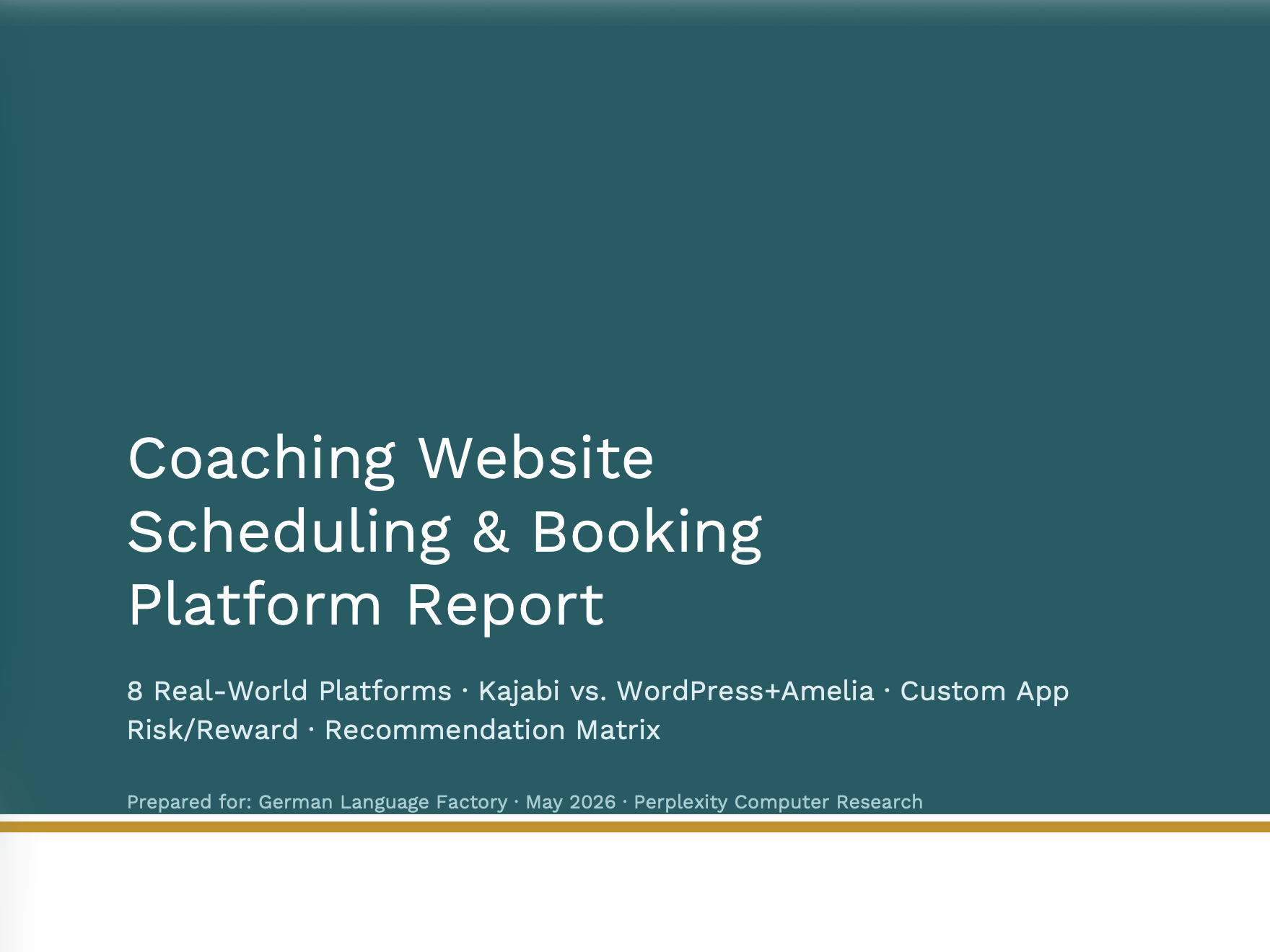
With my startup, I am at this decision point, so I commissioned Perplexity Computer to build a research report comparing eight real‑world platforms plus a custom app path, with data from user reviews, vendor pricing, and industry studies (2026 May). It focuses on five dimensions that matter in practice: monthly cost, client experience, no‑show reduction, setup time, and growth metrics.
In this post I’ll share the highlights and how I’d think about my next move. The full report and recommendation matrix are available for subscribers.
What this research covers
The report looks at:
- Eight major platforms: Calendly, Acuity Scheduling, SimplyBook.me, HoneyBook, Paperbell, CoachAccountable, Kajabi, and WordPress + Amelia.
- A direct comparison of Kajabi versus WordPress + Amelia over a 5‑year horizon.
- A realistic risk/reward analysis for building a custom scheduling app with Perplexity Computer.
- A recommendation matrix mapped to three scales: solo coach (1–5 clients), growing practice (6–50), and multi‑coach/enterprise (50+).
- A concrete recommendation track for a bilingual coaching business.
If you’ve ever felt lost in “tool comparison” rabbit holes, this is designed to be the opposite of that: a clear decision aid.
Fast takeaways before we go deep
Three patterns came through most clearly:
- Speed to launch: If you need to be bookable this week, Calendly still wins. Setup is measured in minutes, and it plugs neatly into whatever website or platform you already have.
- Depth and control: If you already run on WordPress and care about data ownership, GDPR, and bilingual workflows, WordPress + Amelia is the strongest long‑term home base at the lowest recurring cost.
- Coaching‑specific structure: If you want platforms that “think coach,” Paperbell and CoachAccountable start to shine once you have more than a handful of active clients and want real accountability and program structure.
Those three patterns alone are enough to avoid most bad fits. The nuance comes when you combine them with your stage, budget, and desire for technical ownership.
The platforms in plain language
Briefly, how each platform tends to show up in real coaching businesses:
- Calendly: Frictionless scheduling link, high adoption, great for international time zones. Perfect as a first step or as a simple layer on top of any existing stack.
- Acuity Scheduling: Adds intake forms, packages, and payments on top of scheduling. Strong for health, wellness, and coaching where you need more than “pick a time.”
- SimplyBook.me: Feature‑rich booking with multilingual support and a generous free tier. Especially interesting if you coach across borders or in multiple languages.
- HoneyBook: More than scheduling – it’s contracts, invoicing, and client management in one. Useful when you’re tired of duct‑taping multiple tools together.
- Paperbell: Purpose‑built for coaches, with packages, contracts, and a client portal. Best once you have steady client volume and want everything wrapped in a coaching‑centric workflow.
- CoachAccountable: An accountability‑first platform with worksheets, metrics, and progress tracking tied to sessions. Built for serious client follow‑through and multi‑coach setups.
- Kajabi: An all‑in‑one business platform for courses, coaching, email, and community. Makes sense if you’re building a broader digital business, not just scheduling.
- WordPress + Amelia: A low‑recurring‑cost, high‑control option if you’re comfortable (or willing to get comfortable) with WordPress. Strong on ownership, flexibility, and multinational aligned compliance.
The full report goes into detailed pricing, setup time, user ratings, and best‑fit/avoid‑if notes for each. Plus a DIY method that did not exist in 2025: custom app coding using Perplexity Computer.
Kajabi vs. WordPress + Amelia:
the fork in the road
For many coaches, the real decision is not “Calendly vs. Acuity” – it’s this:
Do I want an all‑in‑one managed platform, or do I want to own my stack on WordPress?
If you choose Kajabi
Kajabi is ideal when:
- You plan to build courses, community, and a content library alongside coaching.
- You want one managed platform instead of stitching together multiple tools.
- You’re comfortable with higher fixed costs in exchange for less technical overhead.
You get built‑in course delivery, email, community features, and a client mobile app. The trade‑offs are higher long‑term cost and more vendor lock‑in.
If you choose WordPress + Amelia
WordPress + Amelia is ideal when:
- You already have (or want) a WordPress site you fully control.
- You care about data ownership, GDPR alignment, and audit trails.
- You need multilingual booking and are willing to invest some setup time.
Over five years, the total cost is typically less than half of a comparable Kajabi setup, with more control and flexibility. The trade‑off is that you or someone on your team needs to be willing to manage updates and hosting.
We walk through the numbers and a head‑to‑head feature matrix in the full report.
When a custom app suddenly makes sense
Until recently, “just build a custom app” was unrealistic advice for most coaches. It meant tens of thousands in development costs and months of project management.
With Perplexity Computer, that equation has changed. A focused scheduling and client‑portal app – with bilingual interface, custom reminders, Google Calendar sync, Stripe payments, and ISO‑style audit trails – can be built in hours instead of months.
This path starts to make real sense when:
- You’ve validated your offers and filled your practice using existing tools.
- Platform fees are eating into profit and you want to own the entire workflow.
- You have specific requirements (bilingual, compliance, custom psychology of reminders) that no off‑the‑shelf platform really handles well.
In the report, we break down a 3‑year cost comparison: custom app versus Calendly Teams, Kajabi Growth, and WordPress + Amelia.
A simple 3‑stage action plan
Here’s the high‑level action plan that comes out of the research, especially for a bilingual, systems‑oriented coaching business like German Language Factory:
1. Validate (months 1–3): Use a low‑cost, low‑commitment tool like WordPress + Amelia Starter or a free tier (Calendly or SimplyBook.me) to make booking effortless and measure your no‑show baseline.
2. Optimize (months 4–12): Once you’re consistently working with 6–20 clients, move to a platform that matches your real constraints: Amelia Standard, Acuity, Paperbell, or HoneyBook, depending on whether your biggest pain is scheduling, payment, accountability, or contracts.
3. Scale (12+ months): At 20+ clients and with courses or group programs in play, choose between (a) Kajabi for an all‑in‑one business platform, or (b) a custom scheduling + portal app built with Perplexity Computer to own your entire stack.
The full report includes a scored recommendation matrix across platforms and scales, plus a detailed action plan for each stage.
At the time of writing this, I have not made the decision. Your comments and experience may help me and us.
Leave a comment below.
The space below intentionally left blank for a future update.
Subscriber‑only: the full report and matrix
Continue reading for the platform‑by‑platform breakdown, the Kajabi vs. Amelia feature matrix, the no‑show evidence summary, and the 3‑stage recommendation matrix.
Inside the full report you’ll get:
1. The eight‑platform comparison table with monthly cost, setup time, ratings, best‑fit scenarios, and “avoid if” notes.
2. The complete Kajabi vs. WordPress + Amelia head‑to‑head matrix, including a 5‑year total cost of ownership comparison.
3. A summary of the best available no‑show data and what actually moves no‑show rates in coaching.
4. The 3‑stage action plan in more detail, with specific thresholds to know when it’s time to switch platforms.
5. A custom app risk/reward breakdown, with concrete examples of what Perplexity Computer can build and when it’s worth it.
6. The German Language Factory‑specific recommendation and implementation notes for a multilingual (de/ja), ISO‑aligned coaching operation.
If you’re currently stuck in “research mode” trying to pick a platform, this will save you hours of comparison and reduce the risk of choosing something you’ll outgrow or need to rip out later.
Thanks for reading this far!
Subscribe for free to receive new posts and support my work.
Until I figure out how to auto-reply, we have to take it elsewhere now, that you have seen more clearly what you will get. You may still subscribe, but it will not get you this full report.
Want the full 16‑page PDF report behind this article—with all eight platform profiles, matrices, and the custom‑app cost analysis?
Request the complete Coaching Scheduling & Booking Platform Report (PDF) → [Google Form link]
Thank you.
Bernd
German Language Factory